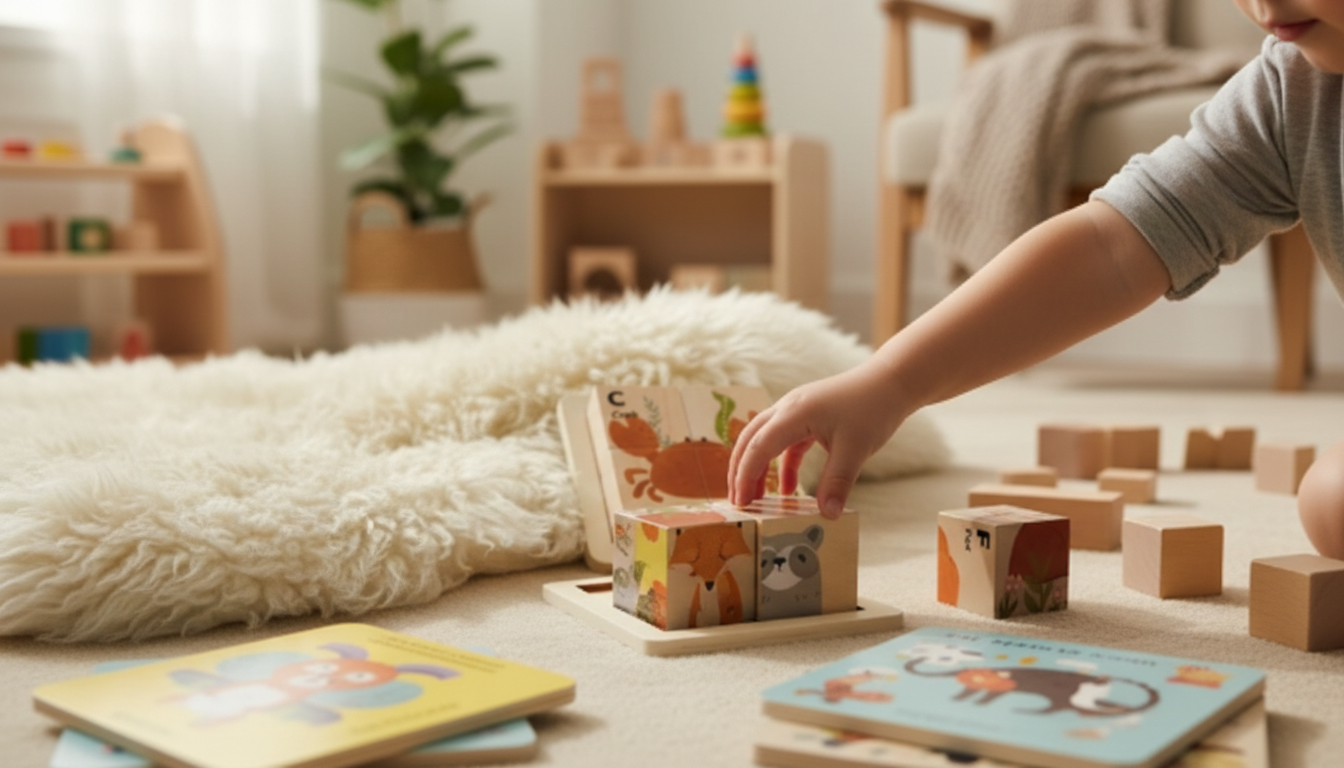
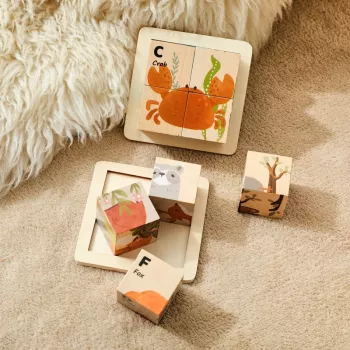
A simple wooden animal puzzle can do a lot when it’s designed for small hands: build focus, strengthen fine-motor control, and turn early problem-solving into an everyday routine. This 6-in-1 set uses familiar animal pictures and chunkier pieces to support independent play while still inviting quick, guided moments with an adult. For more guidance, see Montessori Toys for Toddlers – Novak Djokovic Foundation.
Wooden animal puzzles are a classic early-learning tool because they combine movement, visual thinking, and a clear “start-to-finish” experience. For toddlers and preschoolers, that combination often feels achievable—challenging enough to be interesting, but not so open-ended that it becomes overwhelming. For further reading, see Engage Your Child’s Imagination with the Pet Shape Puzzle.
The beauty of a 6-in-1 set is that it adds variety without changing the routine. Children get the familiarity of the same type of task (matching and placing pieces) with new images to keep interest steady over time.
| Activity | What the child does | Skills supported | Quick adult prompt |
|---|---|---|---|
| Picture match | Find the piece that completes part of the animal image | Visual scanning, attention, working memory | “Look for the piece with the same color/pattern.” |
| Edge-first strategy | Place corners/edges before middle pieces | Planning, sequencing, spatial reasoning | “Which pieces look like they go on the outside?” |
| Two-hand build | Hold board steady with one hand, place piece with the other | Bilateral coordination, core stability, control | “One hand holds, one hand places.” |
| Name and describe | Say animal name and one feature | Vocabulary, expressive language, categorization | “What animal is it? What does it have?” |
| Timed tidy-up | Return pieces to the board and store safely | Executive function, routines, independence | “Let’s put every piece back before we choose the next.” |
Hand-eye coordination develops when children repeatedly practice guiding their hands based on what their eyes see. Puzzles make that feedback loop obvious: if the piece is off by a few millimeters—or turned the wrong way—it won’t settle into the cutout.
For a broader view of what’s typical at different ages, the CDC’s developmental milestones can be a helpful reference for toddlers and preschoolers: https://www.cdc.gov/ncbddd/actearly/milestones/index.html.
A Montessori-style presentation keeps the activity simple, orderly, and child-led—without removing warmth or connection. The adult’s role is to model calmly, then step back so the child can do the real work.
For more on developmentally appropriate learning experiences, NAEYC’s guidance is a strong, practical framework: https://www.naeyc.org/resources/position-statements/dap/contents.
The American Academy of Pediatrics also shares straightforward toy safety tips that are useful when selecting and supervising early-learning toys: https://www.healthychildren.org/English/ages-stages/baby/Pages/choosing-safe-toys.aspx.
| Item | Price | Availability |
|---|---|---|
| Wooden Montessori 6-in-1 Animal Puzzle Set for Early Learning & Hand-Eye Coordination | $6.51 | In stock |
Most wooden animal puzzles work well from toddler through preschool years, with closer supervision for younger toddlers. You can adjust the difficulty by offering one board at a time, using obvious picture cues first, and giving small hints instead of hands-on corrections.
Puzzles train children to look, plan, and move their hands with precision—grasping a piece, rotating it, aligning it to the cutout, and releasing it with control. With repetition, placements become more accurate and confident while fine-motor skills strengthen.
Present one puzzle at a time, demonstrate slowly (even silently), then let the child try with minimal prompting. Encourage independence by keeping the materials in a consistent spot and making tidy-up the final “finished” step.





Leave a comment