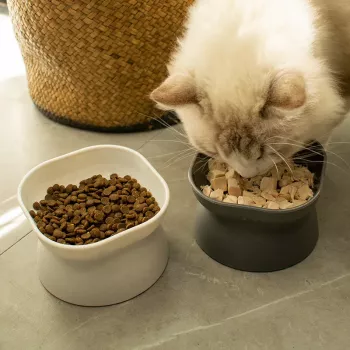
A tilted cat bowl is designed to bring food closer to a natural eating angle, which can help reduce neck strain, keep kibble centered, and make mealtimes feel calmer—especially for cats that eat quickly, hesitate at the bowl, or leave food pushed to the edges. This guide covers what a tilted bowl does, which cats benefit most, how to choose the right size and angle, and how to use it safely for daily feeding.
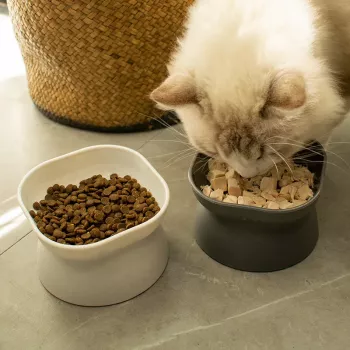
A standard flat bowl often asks a cat to dip the head lower and reach forward as the food level drops. A gentle tilt shifts the “food zone” forward, so the cat can keep a more neutral head-and-neck posture while eating.
Some cats don’t care what bowl you use, while others clearly eat more confidently when the bowl feels “easier.” A tilted bowl can be a simple change that supports comfort and reduces food scattering—especially if you’ve noticed any of the behaviors below.
If your cat is vomiting frequently, seems painful while eating, or has trouble swallowing, a bowl swap shouldn’t replace a vet check. For broader feeding and wellness guidance, the American Association of Feline Practitioners (AAFP) and the Cornell Feline Health Center have helpful cat care resources.
The “best” tilted bowl is the one your cat returns to with relaxed body language and less fuss. Focus on a gentle angle, a comfortable rim, and a base that won’t slide when your cat leans in.
| Cat & feeding style | Bowl shape to prioritize | What to avoid |
|---|---|---|
| Older cat or stiff posture | Gentle tilt + stable base | Very low bowls that force a deep bend |
| Fast eater / messy kibble | Moderate depth + tilt that keeps food centered | Lightweight bowls that slide easily |
| Whisker-sensitive behavior | Wide, shallow bowl with a smooth rim | Narrow bowls with steep inward sides |
| Wet food daily | Smooth, easy-clean surface + stable stand | Porous materials or hard-to-reach creases |
Small setup choices matter. Even a well-designed bowl can feel “wrong” if it slides, sits on an uneven mat, or is filled in a way that makes food drift away from your cat.
See product details and current availability here: Stress-Free Tilted Cat Food Bowl.
A tilted bowl can reduce “chasing” food, but daily cleanup still helps prevent odors and sticky residue—especially if you rotate wet food into the routine. If you like having a simple reset routine for busy days, this guide can help you streamline quick cleanups around pet areas: Clean Faster, Stay Calm – A Stress-Free Speed Cleaning Guide for Busy Homes.
They can “work” by making food easier to reach, helping the cat keep a steadier posture, and reducing how often food gets pushed to the rim. Results vary by the cat, the bowl’s shape and angle, and how stable it is on the floor, so watch comfort and mess levels over 1–2 weeks.
A slight tilt can support a more natural eating angle, keep food pooled toward the front, and reduce frustration from chasing kibble around the edge. Some cats still prefer a flatter setup, so your cat’s behavior is the best guide.
Many cats do fine with a gentle slant, especially with a wide, stable, easy-clean bowl. If your cat has ongoing vomiting, swallowing trouble, or obvious pain while eating, ask your veterinarian before relying on a bowl change.





Leave a comment