
AI is changing healthcare in ways that reach far beyond software and machines. The most important shifts are human: how clinicians make decisions, how teams collaborate, how patients experience care, and how healthcare careers evolve. What’s emerging isn’t “care run by algorithms,” but care shaped by new tools—where people still own outcomes, relationships, and responsibility. The goal is to prepare for new workflows and roles without losing empathy, trust, and accountability.
AI increasingly supports pattern recognition tasks such as triage signals, imaging flags, and risk scoring, but responsibility for outcomes remains with people and institutions. That distinction matters: even when a tool is accurate, someone must decide how to use it, how to document the rationale, and how to communicate uncertainty.
Day-to-day work often shifts toward validating outputs, documenting why a recommendation was accepted or rejected, and clarifying what’s known versus what’s predicted. In many organizations, the biggest early impact is workflow design: who reviews the output, when decisions are escalated, how quickly a care team can act on new information, and what happens when the system is down or a prediction looks wrong.
Successful adoption depends on training, data quality, and clear policies for safety, privacy, and accountability. For regulated software and clinical tools, it also depends on understanding the evolving standards that govern real-world use (see the FDA overview of AI/ML-enabled medical devices).
| Task area | Where AI often helps | Human responsibilities that remain |
|---|---|---|
| Clinical documentation | Drafting notes; summarizing encounters | Confirming accuracy; correcting nuance; ensuring patient voice and consent |
| Diagnostics & imaging | Highlighting anomalies; prioritizing worklists | Clinical judgment; differential diagnosis; explaining results and next steps |
| Population health | Risk stratification; outreach recommendations | Fairness checks; culturally competent engagement; closing care gaps |
| Operations | Scheduling optimization; staffing forecasts | Ethical staffing decisions; managing burnout; patient access priorities |
| Patient support | Chat-based guidance; appointment reminders | Escalation for safety; empathy; shared decision-making |
As automation takes over narrow tasks, uniquely human strengths become even more central to quality and safety.
Many roles won’t disappear; they’ll be rebalanced. Less time may be spent on repetitive clerical work as automation improves, paired with more time reviewing, supervising, and validating outputs. That often means a different kind of cognitive load: monitoring for edge cases, catching subtle inaccuracies, and documenting why a tool’s suggestion wasn’t followed.
New expectations for “AI literacy” are also spreading across clinical and administrative roles—understanding limitations, bias risks, and when not to rely on an automated recommendation. Teams are increasingly expected to communicate, in plain language, how AI influenced a decision and what safeguards exist.
Another shift is organizational: more people are needed to translate between clinical teams, IT, compliance, and leadership. These bridge roles reduce friction by turning real clinical pain points into usable requirements, training plans, and governance processes. At the same time, foundational AI principles—like those outlined by the OECD AI Principles—are becoming practical expectations inside health systems: fairness, transparency, robustness, and accountability.
AI can reduce certain errors while introducing new failure modes. The highest-impact risks to plan for include:
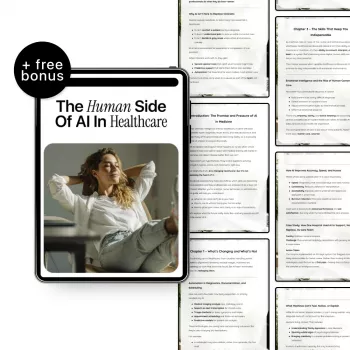
For clinicians, administrators, students, and career-changers, structured guidance can make the shift feel less abstract. The The Human Side of AI in Healthcare ebook guide is a practical resource for identifying which tasks tend to change first—documentation, triage, scheduling, patient messaging, and imaging review are common starting points.
It refers to the people-centered impact of AI—how it changes communication, trust, ethics, accountability, workflows, and careers, not just technology performance.






Leave a comment