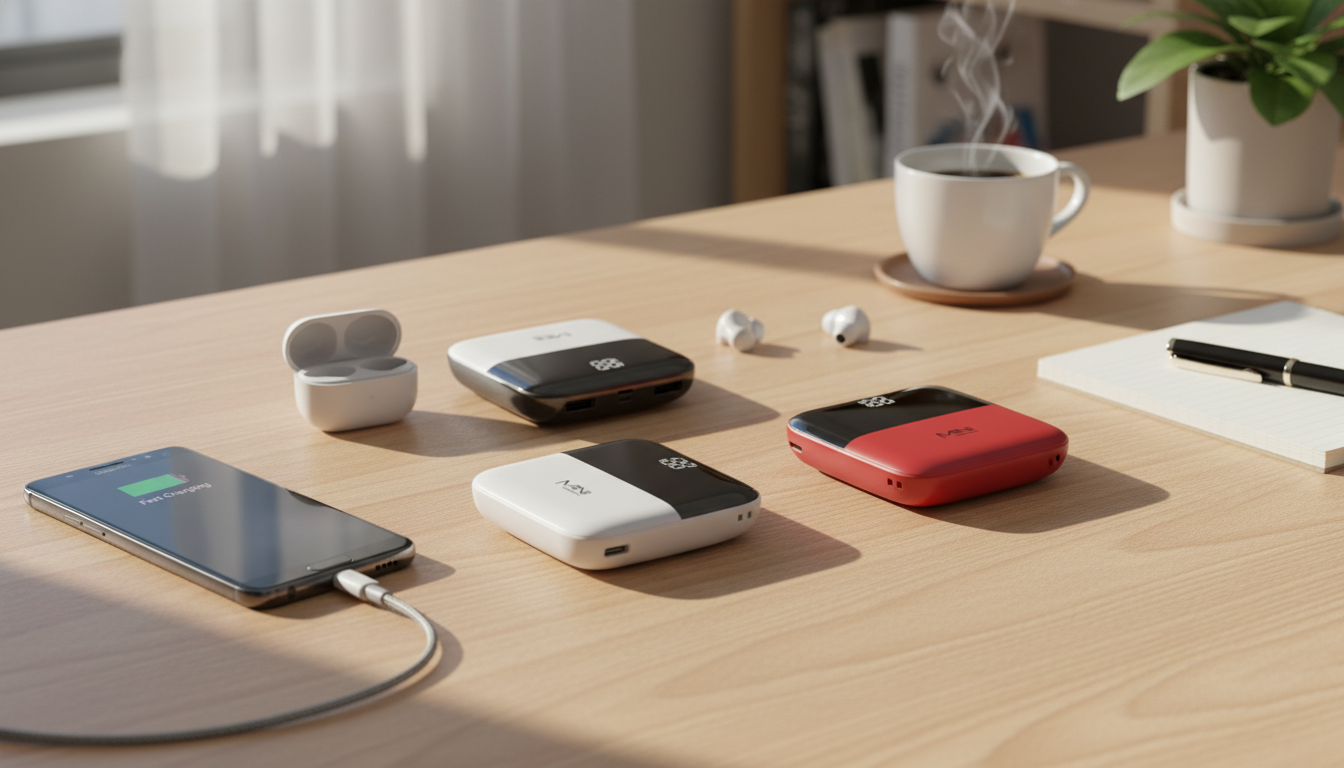
A compact power bank with two USB outputs makes it easy to top up a Samsung phone and a second device at the same time—without hunting for outlets. The practical details matter, though: “fast charging” depends on your phone’s charging standard, the power bank’s output protocol, and the cable you use, while dual ports often share power in real-world use. Below is a clear, everyday guide to choosing and using a mini dual-USB power bank for commuting, campus days, and travel.
Dual USB output simply means the power bank has two ports you can use simultaneously—handy for charging a phone plus earbuds, a phone plus a watch charger, or even your phone plus a friend’s device during a long day out. The convenience is real, but it’s important to understand how power is delivered when both ports are active.
Fast charging isn’t determined by capacity alone (mAh). Charging speed depends on a three-part match: your Samsung phone’s charging support, the power bank’s charging protocol and wattage, and the cable quality. If any one of those is limited, charging drops down to a slower mode.
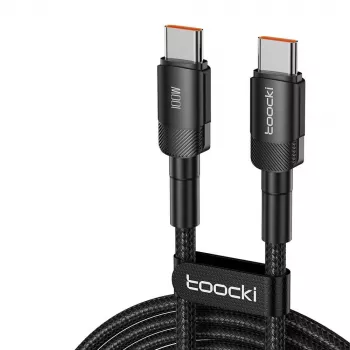
Many modern Samsung phones perform best with USB-C Power Delivery (PD) at appropriate wattage, while older models may rely on other fast-charge methods. If a power bank uses USB-A outputs, fast charging may still engage on some phones, but the maximum speed can be constrained by what the phone and the power bank can negotiate over USB-A. Cable quality also matters more than most people expect—poor cables create voltage drop, extra heat, and slower charging.
| Check | Why it matters | What to look for |
|---|---|---|
| Phone charging standard | Determines whether “fast charging” can engage | USB-C PD / supported fast-charge mode in phone settings |
| Port type on the power bank | Affects available protocols and wattage | USB-C PD preferred for fastest Samsung charging; USB-A may be slower |
| Cable capability | Weak cables throttle speed and increase heat | Shorter, thicker cable; reputable brand; correct connector |
| Single vs dual-device charging | Shared power can reduce speed | Expect slower charge when both ports are in use |
For a deeper explanation of how USB Power Delivery works, the USB-IF overview is a reliable reference: USB-IF: USB Power Delivery.
A mini power bank is designed around portability. It’s the kind of backup battery that fits easily into a pocket, a small crossbody, or the corner of a work bag—ideal for lightweight carry and quick errands. The tradeoff is that smaller units typically offer fewer total recharges than larger “brick” style power banks.
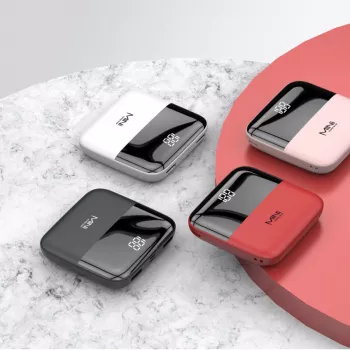
If the goal is a compact, everyday backup that can charge two devices when needed, Mini Power Bank with Dual USB Output for Samsung and Fast Charging is built for that routine: a Samsung phone plus another USB-charged device, all from one small battery pack.
Power banks are generally allowed, but they usually must be carried in cabin baggage because they contain lithium batteries. Restrictions vary by airline and are typically based on watt-hours (Wh) and the number of spare batteries you bring.
The best choice matches your routine: pick a capacity that covers your typical day, prioritize USB-C PD for faster charging on many modern Samsung phones, and choose reputable build quality with clear output ratings. Dual outputs are especially useful if you regularly charge a phone plus a second device.
The best power bank is the one that matches your phone’s fast-charge standard (often USB-C PD for newer Samsung models), provides enough wattage from the right port, and is used with a high-quality cable. A compact dual-USB model is ideal for daily top-ups, while heavy users often prefer higher-capacity PD options.





Leave a comment