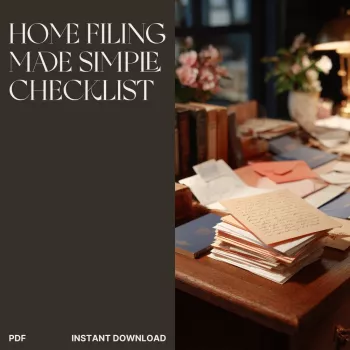
Paper piles grow quietly—mail, receipts, school forms, medical paperwork, and warranty info—until finding one document becomes a mini crisis. A checklist-first filing system removes guesswork by giving every paper a clear decision: act, file, digitize, or toss. The goal is a household file setup that stays simple enough to maintain on a busy week.
A simple system isn’t one with the most folders—it’s one that makes decisions easy. When every document has an obvious next step, paperwork stops migrating from the entryway to the kitchen counter to “that one chair.”
The landing zone is the difference between “we’ll deal with it later” and “we always know where it is.” Choose convenience over perfection—near the place mail naturally enters the home.
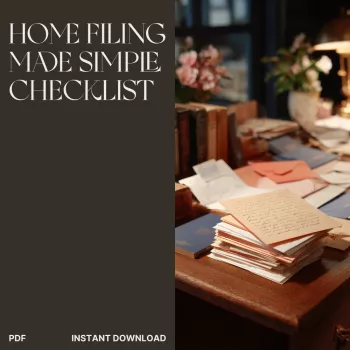
If it helps to stay consistent, use a printed prompt right at the landing zone. The Home Filing Made Simple Checklist (printable guide) is designed for that “what do I do with this paper?” moment.
The fastest way to get unstuck is to stop sorting into vague piles. Every paper gets one of four decisions—no exceptions.
For privacy and identity protection, follow the Federal Trade Commission’s guidance on secure disposal of personal information: https://consumer.ftc.gov/articles/protecting-personal-information.
Start wide and stay flexible. Broad categories reduce decision fatigue; subfolders only appear once a stack becomes annoying to browse. Keep “Action” physically separate from “Archive” so time-sensitive items can’t vanish.
| Category | Example folders | Keep it here |
|---|---|---|
| Money | Taxes, Bank, Credit Cards, Receipts (Important) | File box/drawer |
| Home | Mortgage/Lease, Utilities, Repairs, Manuals & Warranties | File box/drawer |
| Health | Insurance, Medical Bills, Immunizations, Prescriptions | File box/drawer + digital backup |
| Kids/School | Enrollment, Report Cards, Activities, Childcare | File box/drawer |
| Vehicles | Registration, Insurance, Maintenance, Loan | File box/drawer (copies in car if needed) |
| Identity & Legal | Birth/Marriage Certificates, Passports, Estate Docs | Fireproof box/portable file |
| Action | To Pay, To Sign, Appointments, Waiting For | Landing zone |
For tax-related paperwork, the IRS recordkeeping guidance is a solid reference for what to keep and why: https://www.irs.gov/businesses/small-businesses-self-employed/recordkeeping.
Digital backup works best when it’s boring. Pick one method, keep the folder structure small, and scan only the documents that would be painful to replace.
If paperwork overwhelm tends to show up alongside general home clutter, pairing this routine with a short, repeatable cleaning plan can make the whole house feel easier to manage. Clean Faster, Stay Calm (speed cleaning guide) fits well with a “little bit, often” approach.
For a ready-to-print setup you can keep beside your folders, use the Home Filing Made Simple Checklist (printable guide) as your repeatable decision path: Act, File, Digitize, or Shred.
A home filing system is a repeatable way to collect, sort, store, and quickly retrieve household documents. It typically includes one landing zone for incoming papers, a clear split between action items and archived records, a few core categories (like Money, Health, Home), and a simple maintenance routine to keep paper from piling up again.





Leave a comment