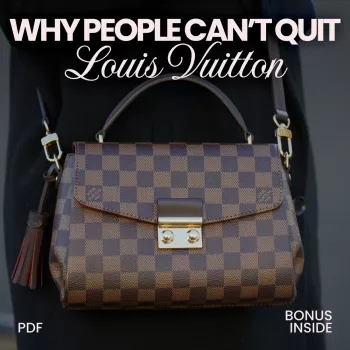
Some brands don’t just sell products—they create rituals, milestones, and a sense of belonging. Louis Vuitton sits at the intersection of heritage craftsmanship, recognizable design, and social meaning, which is why it can feel uniquely “hard to quit.” The forces behind repeat buying are rarely just about a bag holding your essentials; they’re about what the purchase signals, what it rewards, and how it reassures you after you’ve committed. For more guidance, see Consumers’ Implicit Motivation Of Purchasing Luxury Brands – PMC.
Luxury purchasing is almost never only about function. It blends emotion, identity, and reward-seeking behavior—then adds a layer of social feedback that can make the decision feel validated again and again. For further reading, see [PDF] Case Study of Louiss Vuitton-Moet Hennessy – Semantic Scholar.
The strongest pull typically comes from a specific combination: brand history + visibility + perceived quality + social confirmation. One positive ownership moment—an unboxing, a first compliment, a first trip with the bag—can anchor a lasting attachment that’s hard to replicate with another label.
Over time, buying becomes a way to mark life events: promotions, birthdays, travel, relationships, and personal “level-ups.” That meaning can outlast trends, which helps explain why people often return for “just one more” piece.
Use the checklist below to identify which motivations are doing the heavy lifting: practical, emotional, social, or investment-minded. Most buyers have several reasons at once; the mix matters more than any single factor. When the strongest boxes are identity + recognition + reliability, repurchasing becomes far more likely.
| Reason | What it looks like in real life | Why it’s sticky |
|---|---|---|
| Instant recognition | A bag is identifiable from across a room | Reinforces status and taste through visibility |
| Heritage and storytelling | Interest in trunks, travel roots, iconic house codes | Creates meaning beyond the object itself |
| Reward for achievement | “I earned this” purchase after a milestone | Links the brand to pride and self-validation |
| Perceived reliability | Expectations of durability, structure, and finish | Reduces regret and increases confidence in repeat buys |
| Social proof | Friends, influencers, and pop culture normalize ownership | Makes the choice feel safer and more “right” |
| Collecting behavior | Buying seasonal pieces, limited drops, or category expansions | Turns shopping into a hobby with goals and completion |
| Resale and value retention | Comparing secondhand prices, thinking long-term | Adds a financial justification to an emotional purchase |
| Belonging and identity | Feeling part of a “luxury world” or personal style tribe | Deepens attachment; switching feels like losing a signal |
Louis Vuitton’s “house codes” do a lot of invisible work. When patterns, silhouettes, and details recur season after season, familiarity builds trust—and trust lowers friction the next time a shopper considers a purchase.
High recognition can also reduce decision fatigue: buyers already know the “safe” choice will read as premium. Add the product ecosystem effect (wallets, bags, belts, fragrance), and cross-category buying starts to feel coherent rather than impulsive. Importantly, the brand delivers seasonal novelty without total reinvention, so newness arrives without making earlier purchases feel obsolete.
Repeat buying often comes down to three psychological engines:
Scarcity and exclusivity cues (whether real or perceived) can add urgency, while aspirational proximity—the feeling of stepping closer to a world of travel, art, and high status—helps explain why the brand can feel less like an accessory choice and more like a lifestyle marker. For a classic framework on why visible luxury signals can carry social weight, see Encyclopaedia Britannica’s overview of conspicuous consumption.
Durability is one of the most common justifications people lean on when paying premium prices. A luxury bag can be framed as a long-term companion rather than a seasonal accessory—especially when structure, hardware, and finishing details are perceived as consistent.
Repair and care culture extends that story: maintaining an item (through official services or reputable specialists) doesn’t just protect the purchase; it deepens attachment because the owner becomes a steward of the piece. Even when shoppers can’t name every technical detail, the expectation of quality reduces perceived risk—and lower risk makes repeat buying feel more reasonable.
For broader context on how major luxury groups discuss brand performance and long-term strategy, LVMH publishes reporting such as its Universal Registration Document.
Recognizable designs function as social signals in a way subtle products may not. In many social environments, visibility is part of the value: it communicates taste quickly, without requiring explanation.
For a big-picture view of how the luxury market evolves worldwide, Bain & Company’s research is a useful reference point: Luxury Goods insights.
People prioritize different values, experiences, and social cues, so the same purchase can mean “identity and belonging” to one person and “impractical spending” to another. Add differences in language and assumptions, and it’s easy for motives—especially around luxury—to get misread.





Leave a comment